Why Lens?
marimo Pair lets people collaborate with agents on analytical tasks in marimo notebooks. A person can ask questions or give instructions in plain language while the agent inspects data, edits code, and runs the analysis in the live notebook.
When a request concerns a rendered cell output, language alone makes it difficult to identify the cell and the part of its output the person means. The person sees the result and points to what matters. The agent needs the producing cell, its dependencies, and the values that created it. Lens connects what the person sees and points to with the notebook context the agent needs to understand and act on that intent.
A person starts from what they see
An analyst is exploring annual counts of public-domain drawings. The 1937 bar stands out, so they select it and ask whether the spike comes from a few prolific creators or is distributed across many.
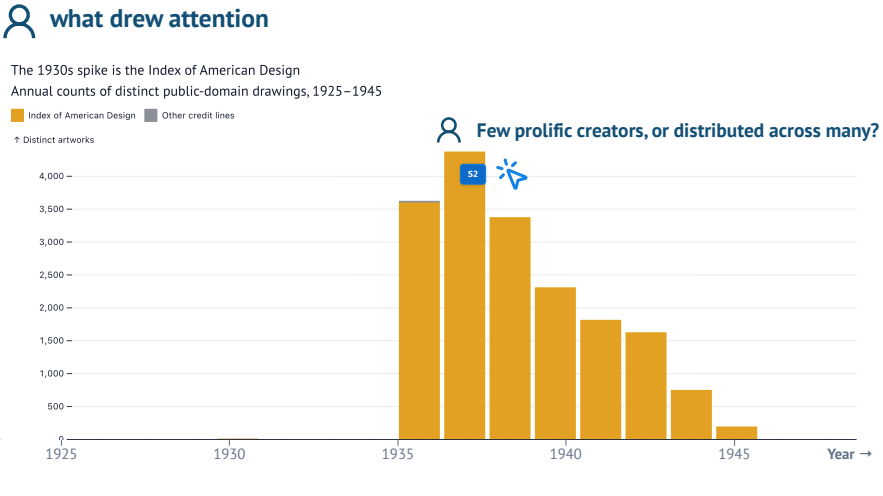
The chart, selected bar, and question preserve what the analyst means. Lens calls this visual grounding. It records the rendered target, the point or region that drew attention, and the analyst's note as one selection.
The agent needs to know how it was made
A marked output tells the agent where the analyst looked, but not which data and transformations produced what they see. To answer from the notebook's data and computation, the agent needs a route to the producing cell, its relevant upstream cells, and the data flowing through them.
That lineage also helps the agent find the right place to change. Feedback attached to a chart may belong in the backing dataset or an earlier analytical step, while the chart code remains unchanged.
marimo represents relationships between cells as a dataflow graph, which records how variables flow from one cell to another. Lens connects the selection to this graph, identifying the producing cell and a bounded set of relevant upstream cells.
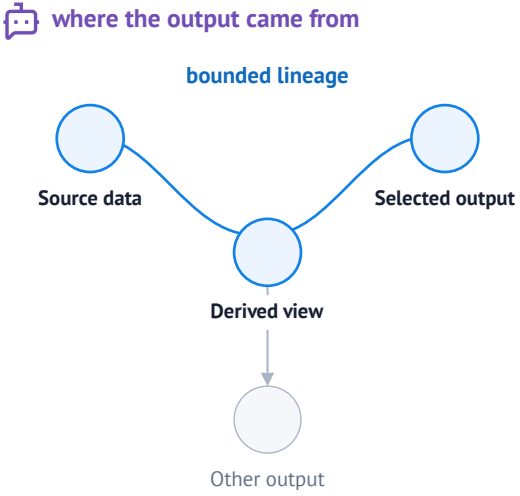
Lens calls this computational grounding. It gives the agent a focused place to inspect the live notebook, test the analyst's question, and revise the analysis.
Connecting attention to computation
Visual grounding answers, “What does the person mean?” Computational grounding answers, “Where did this result come from?” Lens keeps both with the same selection, turning a phrase such as “this bar” into a request tied to visible evidence and notebook computation.
The two forms stay connected through a short collaboration loop:
- Point and ask. The person marks visible evidence and states the question.
- Inspect and revise. The agent follows the relevant notebook context, verifies its interpretation, and changes the live notebook when needed.
- Review and continue. Lens brings the result back into view. The person judges the evidence and directs the next question.
Grounding gives the agent a starting point. The agent still has to interpret the selected region and verify its work. The person still decides whether the result answers the question.
Continue
- Getting started creates the first selection.
- How Lens works shows the complete collaboration loop.
- Context and evidence defines what the agent receives.
- Feedback and History explains review and reopening.