Use Studio in marimohub
marimohub is a self-hosted platform that stores marimo notebooks and runs each session in a sandbox. When a notebook declares marimo-studio, the hub installs Studio into the sandbox, the notebook page opens the Studio authoring workspace, and Run as app serves the view the editor shows.
This guide covers marimohub 0.4.16 and later.
Persist view projects
marimohub copies notebook.py and pyproject.toml into each sandbox and saves them when the session ends. Studio writes view projects to the same sandbox workspace, and the hub saves those files when the deployment sets:
MARIMOHUB_PERSIST_WORKSPACE=workspaceWorkspace persistence saves hidden files such as .env too, and any project member with read access can download them. Keep credentials in the hub's integration secrets.
With the default source value, view files are lost when the session ends, and Add view says so before it creates a view. Git-synced notebooks, temporary editors, and previews save nothing from the session, and Add view warns about those sessions too. For a Git-synced notebook, commit notebook.py and the view folder to the repository before you stop the session, as the hub's marimo-studio steps describe. See the hub's configuration reference for the setting.
Studio marks each view's build cache and unfinished builds with a CACHEDIR.TAG file, and the hub leaves tagged folders out of the saved workspace. A notebook with a React view and an HTML view saves about 3 MB: the view sources plus their built revisions. The first build in a new session downloads the view's packages again.
Studio edits view projects inside the sandbox workspace, so that workspace must use supported storage. Hub backends that copy the workspace into the sandbox meet that requirement. The Cloudflare backend mounts the workspace bucket into the sandbox with s3fs instead, and Studio stops view creation and builds there with a concurrent-change error.
Add Studio to the notebook
In the project's notebook list, open the notebook's actions menu, choose Browse files, and open notebook.py. Add this header at the top of the file and click Save:
# /// script
# dependencies = ["marimo-studio>=0.3.0"]
#
# [tool.marimo-studio]
# default = "dashboard"
# view_root = "studio"
# ///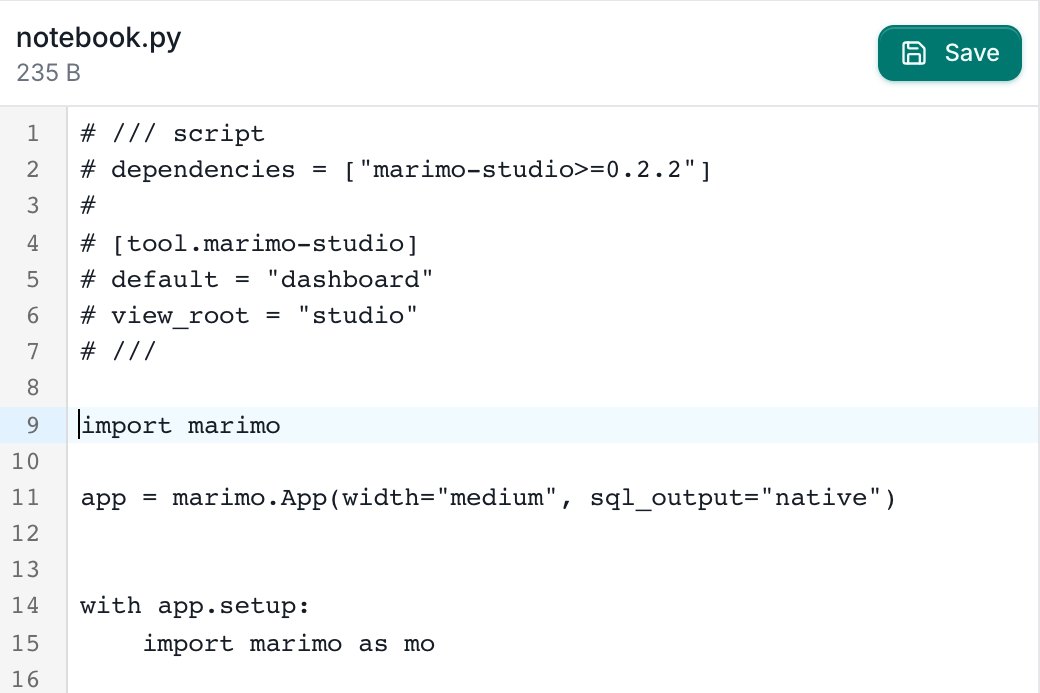
The header is a PEP 723 script block, which stores dependencies and tool configuration inside the notebook file:
| Entry | Effect in marimohub |
|---|---|
dependencies | The hub installs inline dependencies when a sandbox starts |
default | Names the view that Add view proposes and that an app link without a view path serves |
view_root | Stores view projects in studio/ beside the notebook, where Browse files and a synced Git repository show them |
The HTML document starter needs no extra packages. React, Svelte, Reveal.js slides, and Notebook Kit starters need marimo-studio[deno]>=0.3.0 in dependencies and network access to the npm registry.
Browse files is read-only while an editor session runs, so stop the session first. The saved header creates a new notebook version. Dependency changes apply at the next sandbox start, and the first start after adding Studio spends extra time installing it. For a Git-synced notebook, add the header in the repository and sync again.
Studio 0.3 runs on marimo 0.25.1, so the sandbox image must provide that marimo version. See Supported environment.
To bring a new notebook into the hub, save the header in a local notebook.py and choose that file under Start from a file in the New Notebook dialog.
Create the first view
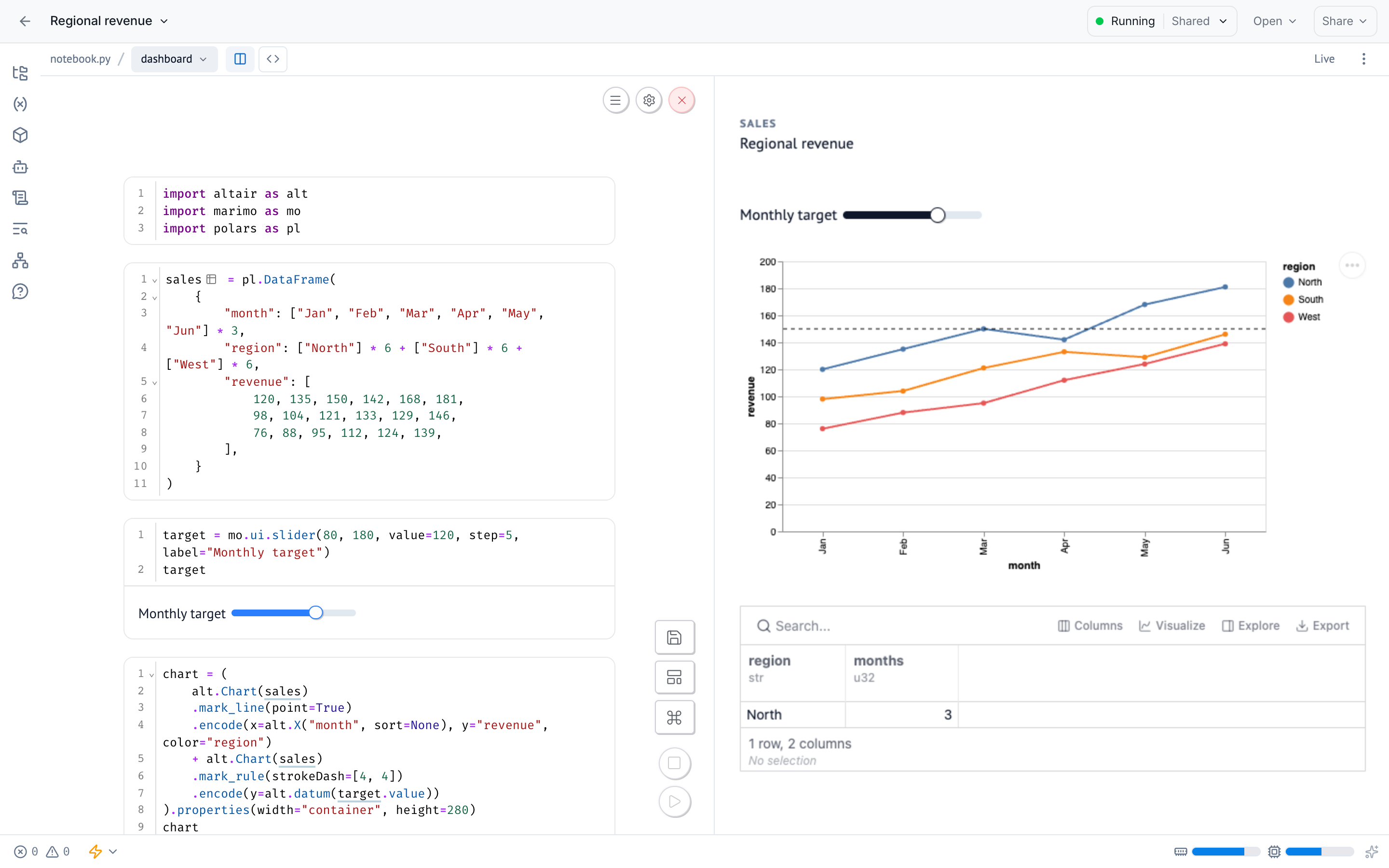
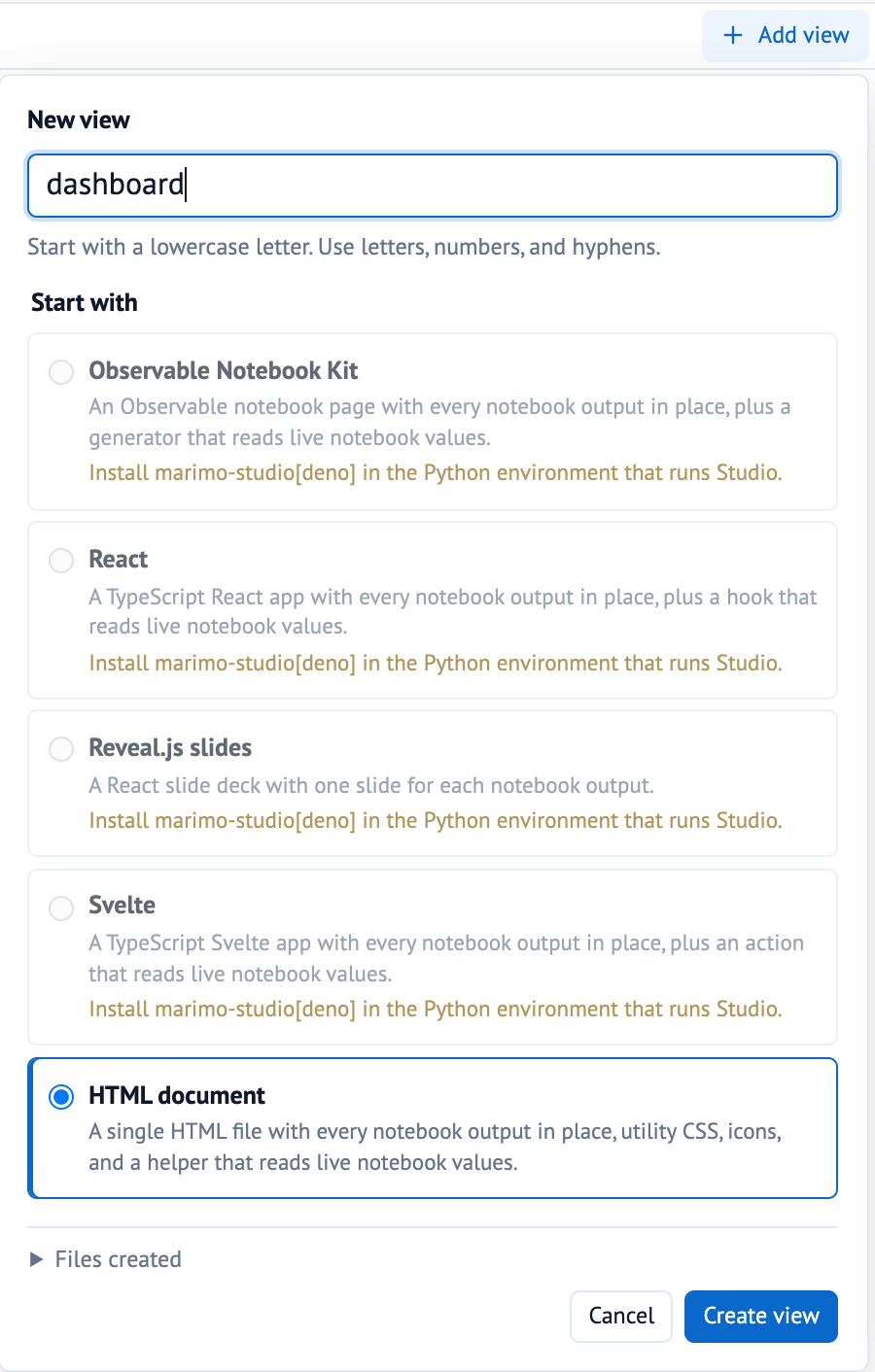
Open the notebook. The hub page shows the native marimo editor with an Add view button in the Studio toolbar. Run the notebook's cells, click Add view, keep the proposed name dashboard, choose HTML document, and click Create view.
Notebook and Preview open side by side. Controls in Preview drive the same kernel as the notebook, so moving a slider in the view reruns the dependent cells and updates both panes.
View creation also rewrites the notebook header. It pins a Studio version range to the installed version, for example marimo-studio==0.3.0, and records aliases for the cells the starter placed. A direct reference such as marimo-studio @ https://example.com/marimo_studio-0.3.0-py3-none-any.whl stays as written, so the next sandbox installs the same build. The hub saves those changes with notebook.py.
Continue with Edit and preview in Studio and Place notebook results in a view to shape the page.
Check the saved view project
Stop the session from the hub's session menu when you finish. The hub saves notebook.py and the workspace, and Browse files shows the view project:
notebook.py
pyproject.toml
studio/
  dashboard/
    AGENTS.md
    index.html
    view.toml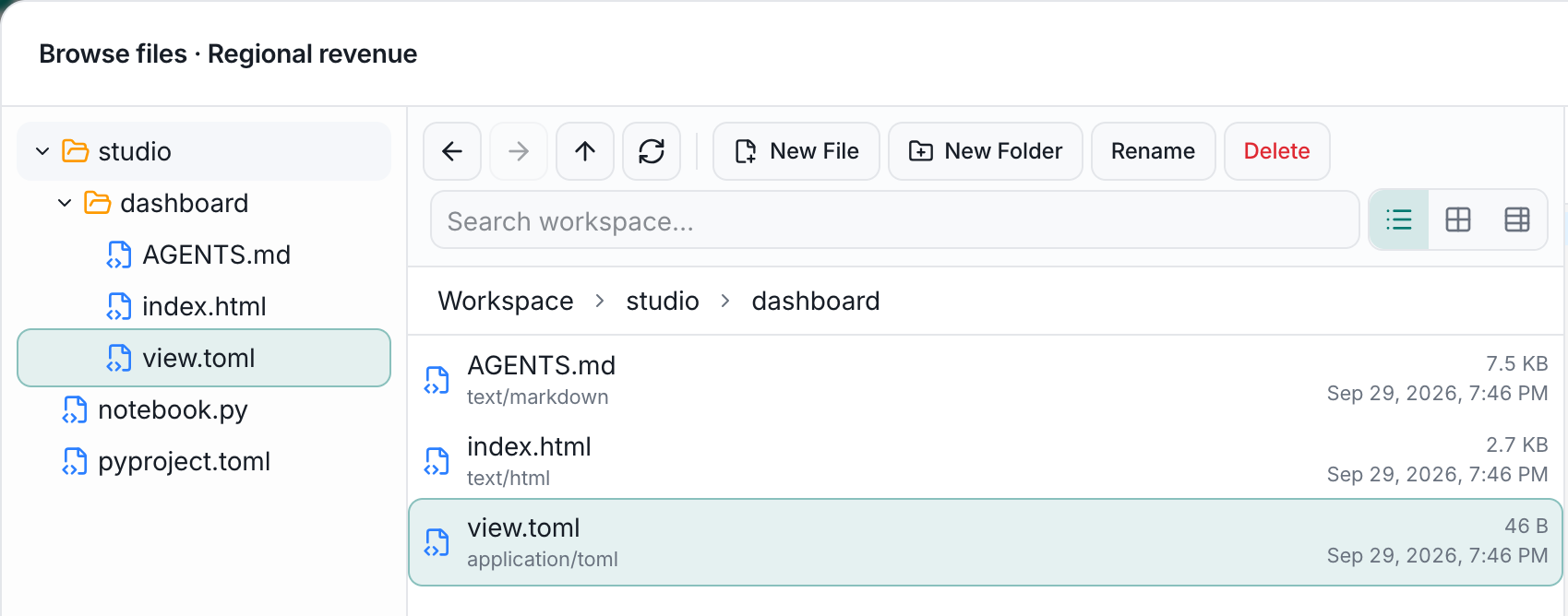
The next session restores studio/ into a fresh sandbox and opens Studio on the dashboard view with its saved source.
Run the view as an app
Choose Open, then Run as app. The hub starts the notebook with marimo run, and Studio serves the view the editor shows.
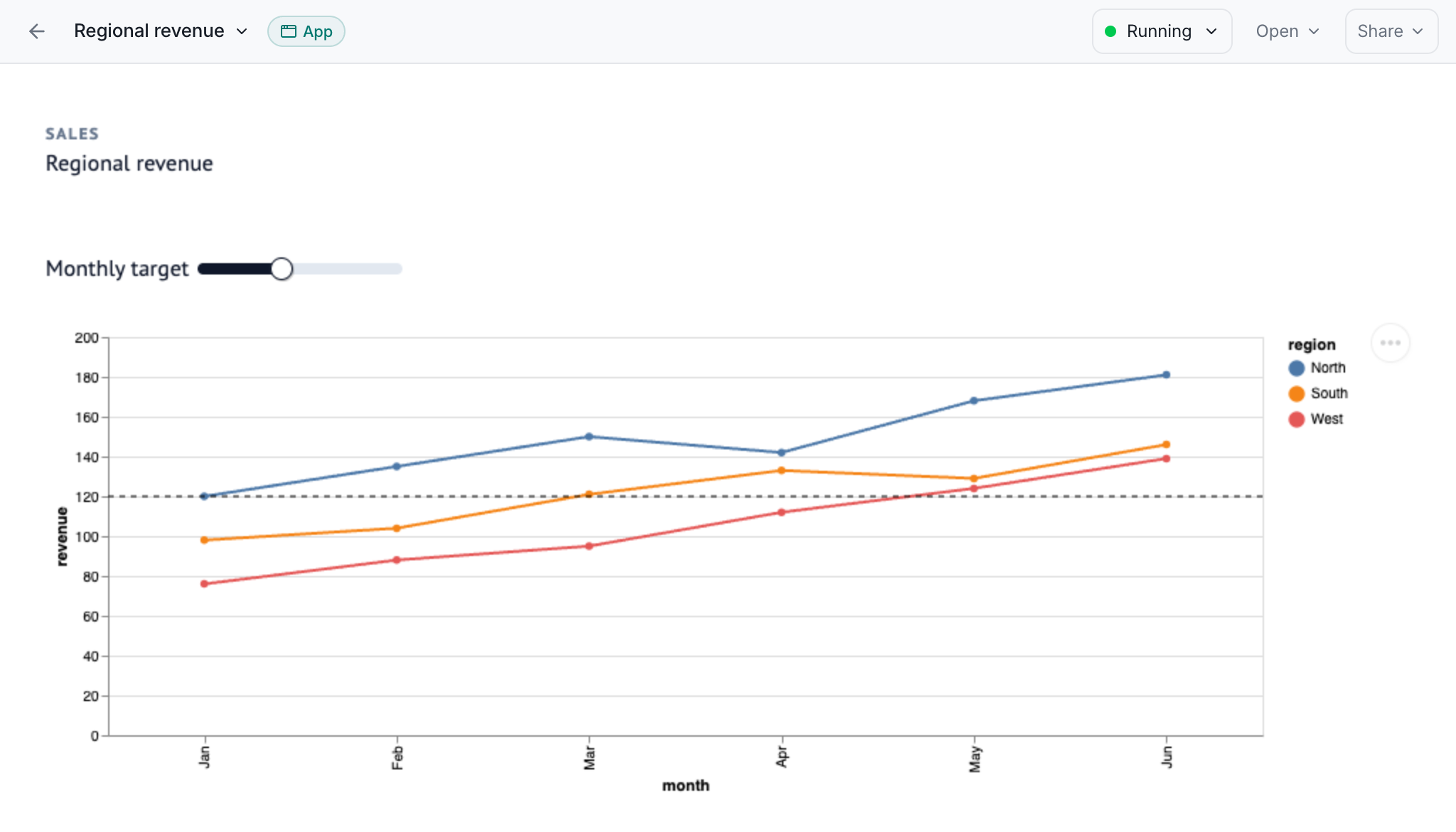
The hub mirrors the path of its notebook frame into the __mh_path query parameter, so a reload, Copy URL, Run as app, and app links reopen the same view. For example, /app/sales?__mh_path=report%2F opens the report view of the app named sales. An app link without __mh_path serves the default view.
An app builds a view's production revision the first time a visitor opens it. With MARIMOHUB_PERSIST_WORKSPACE=workspace, build that revision for a React, Svelte, Reveal.js, or Notebook Kit view before you stop the editor session, and the app serves it without a build. Run this code through the hub's MCP execute_code or marimo pair, as Coding agents in marimohub shows:
import marimo_studio

await marimo_studio.agent.current_workspace().view("dashboard").build(
    profile="production"
)
Run or export a view covers runtimes and static export for the same view outside the hub.
Serve Preview behind a sign-in
Preview runs view code in a sandboxed frame with an opaque origin, so its requests carry no cookies. A sign-in that checks a cookie on every request rejects them, and after 10 seconds Preview reports The preview cannot reach the Studio server.
MARIMOHUB_SANDBOX_EXPOSURE sets where the hub serves each sandbox:
| Exposure | Sandbox address | Preview |
|---|---|---|
subdomain (default) | Its own domain | Fails behind a login proxy |
proxy | Hub origin, /proxy/<token>/ | Works behind the hub sign-in |
With proxy exposure, notebook output already runs on the hub origin, which is why the hub requires MARIMOHUB_SANDBOX_PROXY_ACK_UNTRUSTED=true. Studio reads the exposure from the hub's sandbox context and serves Server runtime views on that origin too, where requests carry the hub sign-in cookie.
Behind a login proxy on the sandbox domain, add MARIMO_STUDIO_TRUSTED_SERVER_RUNTIME=1 to the project's Environment variables integration, then restart the session. Server runtime code then runs on the sandbox origin with its cookies, local storage, and same-origin requests. With proxy exposure, set it to 0 to keep Server runtime views in their opaque frame. See Process settings.
Coding agents in marimohub
Coding agents author views through Studio's agent API in the live notebook kernel. In a marimohub session, workspace.status() reports in persistence whether the hub saves view files. In code mode, view.preview_url() returns the view's address on the sandbox's public URL. MARIMOHUB_SANDBOX_AUTH=on makes marimo in each sandbox require an access token, and the exposure decides who can open that URL:
| Exposure and sandbox authentication | Who can open the preview URL |
|---|---|
proxy | People signed in to the hub who can open the session |
subdomain with on | Browsers signed in to the session's marimo server |
subdomain with off, the default | Anyone with the URL, who can then run code in the session's kernel |
Open the preview URL in your own browser, and share the notebook page with other people.
Agents in the sandbox
VS Code and OpenCode surfaces run beside marimo in the edit sandbox. The hub gives their terminals and agents the kernel's address in MARIMOHUB_KERNEL_URL and its access token file in MARIMOHUB_KERNEL_TOKEN_FILE, which is empty when sandbox authentication is off. Pass both to marimo pair on every call:
kernel_args=(--url "$MARIMOHUB_KERNEL_URL")
if [[ -n "${MARIMOHUB_KERNEL_TOKEN_FILE:-}" ]]; then
  kernel_args+=(--token-file "$MARIMOHUB_KERNEL_TOKEN_FILE")
fi
uv run --no-sync marimo pair execute "${kernel_args[@]}" --code-file - <<'PY'
import marimo_studio
print(await marimo_studio.agent.current_workspace().status())
PY
The hub owns the session's marimo server. Attach to it through marimo pair, and start no other server. Continue with Author with a coding agent.
Agents over MCP
A coding agent connected to the hub's MCP server edits views through the same kernel. start_session opens an edit session, and execute_code runs Studio's agent API in it:
import marimo_studio

view = marimo_studio.agent.current_workspace().view("dashboard")
document = await view.read("index.html")
updated = document.content.replace("<h1>Dashboard</h1>", "<h1>Revenue</h1>")
await view.write("index.html", updated, expected_revision=document.revision)
build = await view.build()
print(build.revision, (await view.inspect()).freshness)
The printed freshness is current after a successful build, and an open notebook page shows the new heading in Preview.
start_session initializes the kernel without a browser when the deployment sets MARIMOHUB_SANDBOX_AUTH=on. Otherwise it reports awaiting_client, and the notebook page must load once before execute_code runs. view.show() needs an open notebook page, because it switches that page's Studio workspace to the view.
Troubleshoot
| Symptom | Fix |
|---|---|
| The notebook page shows the marimo editor with no Studio toolbar | Check that dependencies lists marimo-studio, then stop and restart the session |
| Add view warns that view files are lost when the session ends | Set MARIMOHUB_PERSIST_WORKSPACE=workspace on the hub. For a Git-synced notebook, commit notebook.py and the view folder before you stop |
| Run as app shows the notebook instead of the view | Run mode serves the notebook as a marimo app while the view root contains no view. See Persist view projects |
A starter asks for marimo-studio[deno] | Change the dependency to marimo-studio[deno]>=0.3.0 and restart the session |
| Preview reports The preview cannot reach the Studio server. | See Serve Preview behind a sign-in |