

Add a view provider
A view provider is a small Python package that adds starters to Studio's New view picker. Install one in the notebook's environment, and its starters appear beside the built-in HTML, React, Svelte, and Notebook Kit starters:
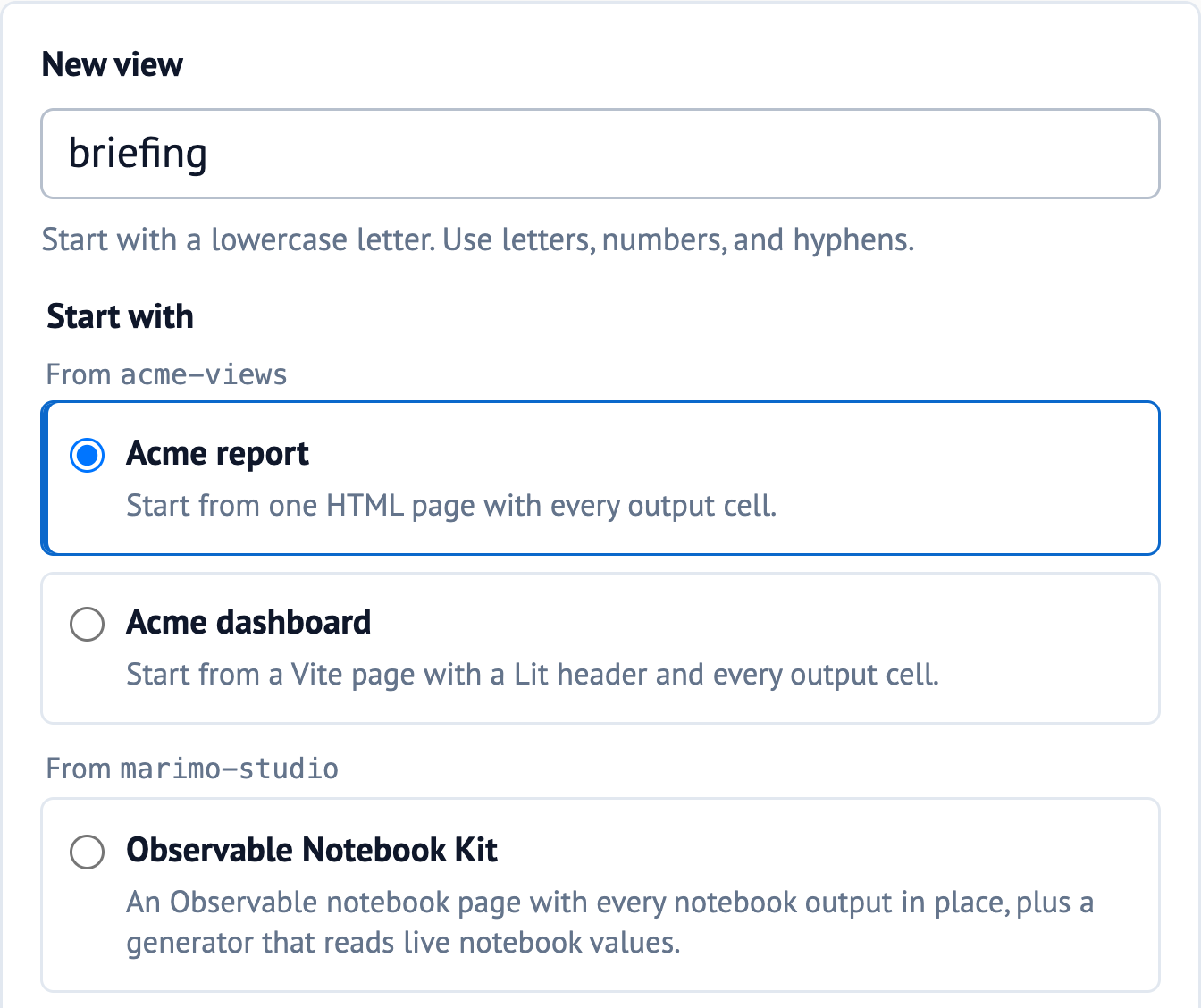
This page builds acme-views, the package in that picker. Acme report starts a plain HTML page and needs Python alone. Acme dashboard adds a Lit component bundled by Vite. Each view stays an ordinary frontend project, so people and coding agents edit it with that framework's own files and commands.
Advanced feature
The view provider API is an advanced extension point. A future release may change it to reduce the code a provider needs, and Studio plans to ship a dedicated agent skill for writing providers. Studio requires an exact PROVIDER_API_VERSION match, so pin marimo-studio to the minor line you test, such as marimo-studio>=0.3.0,<0.4.
Ask a coding agent
A coding agent can build a provider from this page. Open one in the notebook's project and paste this prompt:
Read https://marimo-team.github.io/marimo-studio/guide/view-providers.md
and https://marimo-team.github.io/marimo-studio/reference/provider-api.md.

Create the guide's acme-views package in ./acme-views for analysis.py, with
the Acme report starter and the Acme dashboard starter, a Vite page with a
Lit header and every output cell. Follow "Add a framework build" and the
"Provider rules". Install the package with `uv add --editable ./acme-views`,
run every command in "Verify the provider", and fix each failure before
you stop.
To target another framework, replace Lit in the prompt with its name. Swap Lit for a JSX framework lists what changes. The rest of the page builds the same package by hand.
What a provider decides
Pick Acme report, name the view briefing, and Studio creates a view project beside the notebook:
__marimo__/studio/analysis/briefing/
  view.toml    names the provider that owns this view
  index.html   the page, with one <marimo-cell> host per output cell
  AGENTS.md    instructions for coding agents that edit this view
Studio writes view.toml. The provider writes everything else and decides how Studio treats each file. A Source document appears in Studio's Source panel, where people and agents edit it. A build input is a file whose change rebuilds the page.
| File | Written by | Source document | Build input |
|---|---|---|---|
index.html | the provider, at creation | yes | yes |
AGENTS.md | the provider, at creation | yes | no |
DESIGN.md | the user or an agent, later | yes, once it exists | no |
AGENTS.md tells a coding agent how the project fits together: which file holds the page, what the <marimo-cell> hosts mean, and where decisions belong. The marimo-studio agent skill reads it before editing a view, so a provider ships one written for its framework.
DESIGN.md records lasting decisions such as audience, visual direction, and interaction priorities. Starters leave it out. The user or an agent adds it once the view has a direction, and agents read it before styling.
Neither Markdown file shapes the built page, so editing them never triggers a rebuild.
Studio calls the provider at four moments, and Write the provider covers each one:
| When | Studio calls |
|---|---|
| Someone opens the New view picker | availability(), starters() |
| Someone creates a view | create() |
| Source opens, or a watched file changes | inspect() |
| Preview, run mode, or export needs a fresh page | build() |
How Studio finds the provider
The package advertises the provider through the marimo_studio.view_providerentry point group, the Python packaging mechanism that lets an installed package publish objects to other packages. Studio turns that registration into the names people see:
| Name | Value | Made from |
|---|---|---|
| Registration | report = "acme_views:provider" | Entry point in the acme-views package |
| Provider key | acme-views/report | Distribution name and registration name |
| Starter ID | acme-views/report:default | Provider key and the starter's key |
| View record | provider = "acme-views/report" | Written to view.toml at creation |
Studio reads the entry points once per process, from the Python environment it runs in. Restart marimo edit after you install a provider or change its starters. When a provider reports itself unavailable, the picker disables its starters and shows the recovery action it returned.
Create the package
From the notebook's project, create a library with uv, the Python package manager Studio uses to resolve notebook environments:
uv init --lib acme-views
cd acme-views
uv add "marimo-studio>=0.3.0,<0.4"
When the notebook's directory is a uv project, uv init adds acme-views to its workspace. Register the provider in acme-views/pyproject.toml:
[project.entry-points."marimo_studio.view_provider"]
report = "acme_views:provider"
Write the provider
Replace src/acme_views/__init__.py with:
import html
from html.parser import HTMLParser
from pathlib import PurePosixPath

from marimo_studio.view_providers import (
    PROVIDER_API_VERSION,
    BuildRequest,
    BuildResult,
    CellSpec,
    InspectionRequest,
    MountDeclaration,
    NotebookSpec,
    ProjectInput,
    ProjectInspection,
    ProviderAvailability,
    ProviderInfo,
    ProviderStarter,
    SourceDocument,
    SourceLocation,
    StarterContext,
    StarterPlan,
    ViewProject,
    mount_attribute,
)

ENTRY = PurePosixPath("index.html")
AGENTS = PurePosixPath("AGENTS.md")
DESIGN = PurePosixPath("DESIGN.md")
MANIFEST = PurePosixPath("view.toml")
TAG = "<marimo-cell"

AGENTS_SOURCE = """# Acme view

Studio builds this view from `index.html` with the Acme provider.

- Each `<marimo-cell name="...">` in `index.html` shows the notebook cell with
  that name. Move or remove hosts freely and keep their `name` values.
- Keep calculations in the notebook, and layout and wording in this project.
- Record audience and visual decisions in `DESIGN.md`.
"""


class CellHosts(HTMLParser):
    """Collect each <marimo-cell name="..."> host with its source position."""

    def __init__(self, source: str) -> None:
        super().__init__()
        self.hosts: list[tuple[str, int, int]] = []
        self.feed(source)

    def handle_starttag(self, tag: str, attrs: list[tuple[str, str | None]]) -> None:
        if tag == "marimo-cell" and (name := dict(attrs).get("name")):
            line, offset = self.getpos()
            self.hosts.append((name, line, offset + 1))


def enabled_cells(notebook: NotebookSpec) -> list[CellSpec]:
    """Return ordinary cells that run: neither disabled nor below a disabled cell."""
    cells = notebook.by_ref()
    disabled = {cell.ref for cell in notebook.cells if cell.config.disabled}
    pending = list(disabled)
    while pending:
        for child in cells[pending.pop()].downstream:
            if child not in disabled:
                disabled.add(child)
                pending.append(child)
    return [
        cell
        for cell in notebook.cells
        if cell.kind == "cell" and cell.ref not in disabled
    ]


def instrument(source: str, mounts: tuple[MountDeclaration, ...]) -> str:
    """Add Studio's mount attribute to each declared <marimo-cell> host."""
    lines = source.splitlines(keepends=True)
    for site in reversed(mounts):
        name, value = mount_attribute(site.id)
        row = site.source.line - 1
        cut = site.source.column - 1 + len(TAG)
        lines[row] = f'{lines[row][:cut]} {name}="{value}"{lines[row][cut:]}'
    return "".join(lines)


class ReportProvider:
    info = ProviderInfo(
        title="Acme report",
        summary="One HTML page with the notebook's output cells.",
        api_version=PROVIDER_API_VERSION,
    )
    starter = ProviderStarter(
        key="default",
        title="Acme report",
        summary="Start from one HTML page with every output cell.",
        documents=(ENTRY, AGENTS),
    )

    def availability(self, project: ViewProject | None = None) -> ProviderAvailability:
        return ProviderAvailability(True)

    def starters(self) -> tuple[ProviderStarter, ...]:
        return (self.starter,)

    def create(self, starter: ProviderStarter, context: StarterContext) -> StarterPlan:
        cells = tuple(
            context.cell_targets[cell.ref]
            for cell in enabled_cells(context.notebook)
            if cell.may_display_output
        )
        hosts = "\n".join(
            f'      <marimo-cell name="{html.escape(item.target)}"></marimo-cell>'
            for item in cells
        )
        page = f"""<!doctype html>
<html lang="en">
  <head><meta charset="utf-8"><title>{html.escape(context.view_name)}</title></head>
  <body>
    <main id="app-shell">
{hosts}
    </main>
  </body>
</html>
"""
        files = {ENTRY: page.encode(), AGENTS: AGENTS_SOURCE.encode()}
        return StarterPlan(files=files, cell_targets=cells)

    def inspect(self, request: InspectionRequest) -> ProjectInspection:
        root = request.project.root
        source = (root / ENTRY).read_text(encoding="utf-8")
        mounts = tuple(
            MountDeclaration(
                id=f"cell-{index}",
                kind="cell",
                source=SourceLocation(ENTRY, line, column),
                allowed_targets=(name,),
            )
            for index, (name, line, column) in enumerate(CellHosts(source).hosts)
        )
        documents = [
            SourceDocument(ENTRY, "html", "edit"),
            SourceDocument(AGENTS, "markdown", "edit"),
        ]
        if (root / DESIGN).is_file():
            documents.append(SourceDocument(DESIGN, "markdown", "edit"))
        return ProjectInspection(
            editor_documents=tuple(documents),
            input_scope=(ProjectInput(ENTRY, "file"), ProjectInput(MANIFEST, "file")),
            mounts=mounts,
            diagnostics=(),
            build_fingerprint="acme-report-v1",
        )

    def build(self, request: BuildRequest) -> BuildResult:
        source = (request.project.root / ENTRY).read_text(encoding="utf-8")
        page = instrument(source, request.inspection.mounts)
        (request.staging_root / ENTRY).write_text(page, encoding="utf-8")
        return BuildResult(ENTRY, ())


provider = ReportProvider()
ReportProvider answers the four moments from What a provider decides, one method at a time.
availability() and starters(): fill the picker
When someone opens New view, Studio asks each provider whether it can run and which starters it offers. ReportProvider needs nothing beyond Python, so availability() always returns ProviderAvailability(True).
starters() returns one ProviderStarter. Its title and summary become the card in the picker, and documents becomes the Files created list. Studio keeps the starter list for the life of the process.
create(): write the starting files
create() runs once, when someone clicks Create. It receives the saved notebook in context.notebook and returns every file of the new project in a StarterPlan. ReportProvider writes one <marimo-cell> host into index.html for each cell that may display output, and adds AGENTS.md.
enabled_cells() leaves out disabled cells and every cell downstream of one, because marimo never runs a cell whose inputs come from a disabled cell. The built-in starters apply the same rule.
context.cell_targets supplies the name each host uses. A named cell such as summary keeps its name. For an unnamed cell, Studio proposes an alias such as cell-2 and saves it in the notebook when the provider returns that target in StarterPlan.cell_targets.
inspect(): describe the project
Studio calls inspect() whenever it needs the project's current shape: when Source opens, when a watched file changes, and before each build. The ProjectInspection it returns has three parts.
editor_documents fills the Source tabs with index.html, AGENTS.md, and DESIGN.md once that file exists. input_scope names the build inputs, index.html and view.toml. Studio rebuilds when one of them changes, which is why edits to the Markdown files leave the page alone.
mounts holds one entry per <marimo-cell> host. A mount lets that spot in the page show exactly the cell it names. CellHosts records each host's line and column, so Studio can point an error at the right place in Source.
build(): publish the page
build() runs when Preview, run mode, or export needs a page for the current files. request.project.root holds a snapshot of the build inputs. ReportProvider reads index.html, adds the attribute from mount_attribute() to each host so Studio can connect it to the notebook, and writes the result to request.staging_root. The index.html in Source keeps its original markup.
Studio validates the staged files and publishes them as a new revision. A failed build leaves the last good revision in Preview.
Install it and create a view
From the notebook's project, install the package and ask Studio what it sees:
uv add --editable ./acme-views
uv run marimo-studio doctor acme-views/reportavailable acme-views/report
distribution acme-views
registration report
installed 0.1.0
One HTML page with the notebook's output cells.
starters acme-views/report:defaultinstalled reports the version of acme-views.
Start uv run marimo edit analysis.py, open the view menu, and choose New view. Acme report waits under From acme-views, and Files created lists index.html, AGENTS.md. The CLI creates the same view:
uv run marimo-studio view create briefing \
  --target analysis.py \
  --starter acme-views/report:default
Open Source to see the provider's choices. The page holds one host per output cell. Now give the view a design direction by saving __marimo__/studio/analysis/briefing/DESIGN.md:
# Design

Audience: the weekly operations review.
Lead with the threshold control, then its result.
Studio lists DESIGN.md the next time it inspects the view, such as after the next save of index.html:
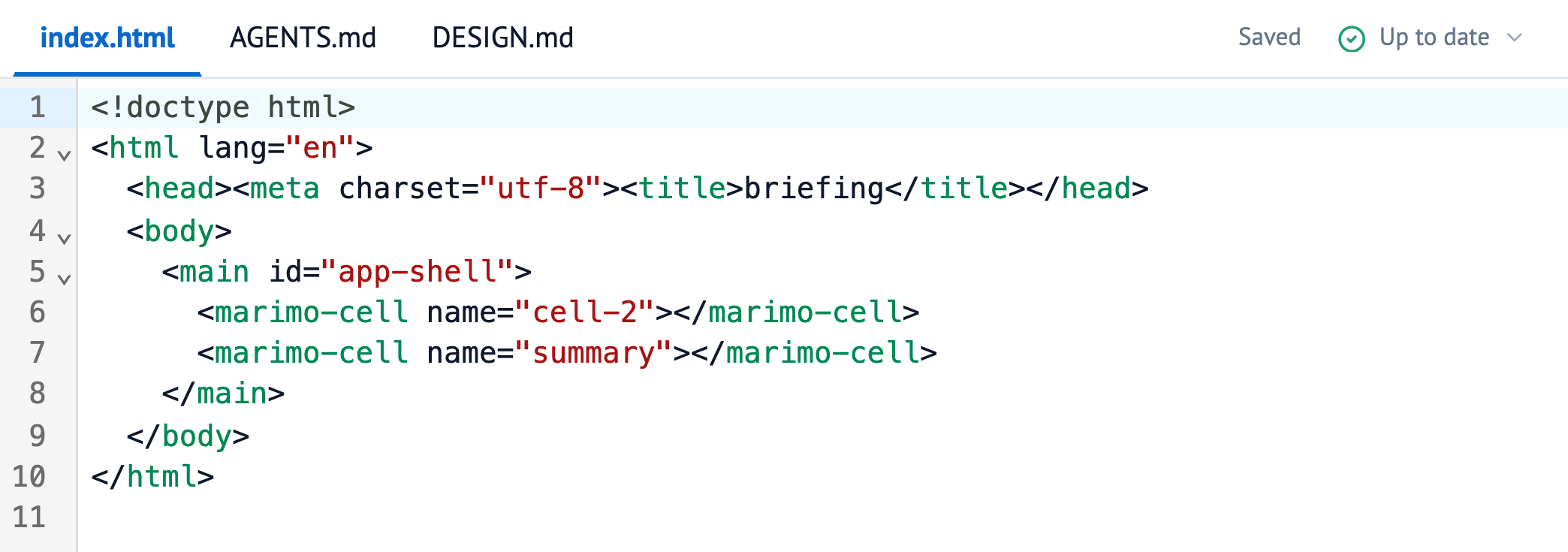
Every environment that edits, builds, or exports the view needs the provider package. Publish it to a package index, or declare it as a path or Git source in the notebook's project, so uv can install it wherever the notebook runs.
Add a framework build
Acme dashboard bundles a Lit component with Vite, a frontend build tool. Vite needs a JavaScript runtime, and the machine that opens the notebook may lack Node.js and npx. Deno fills that role. It is a JavaScript and TypeScript runtime that also installs npm packages, and it ships on PyPI as the deno package. Declared as a Python dependency, it lands in the same environment as Studio, and deno.find_deno_bin() returns its path. The built-in React, Svelte, and Notebook Kit providers use the same package.
Add the dependency from acme-views and register a second provider:
uv add deno[project.entry-points."marimo_studio.view_provider"]
report = "acme_views:provider"
vite = "acme_views.vite:provider"Pin the dashboard's npm packages
The dashboard starter copies three files into every new view. Keep them in the package, in src/acme_views/dashboard/.
main.js defines the Lit header:
import { html, LitElement } from "lit";

customElements.define(
  "acme-header",
  class extends LitElement {
    render() {
      return html`<h1>Acme dashboard</h1>`;
    }
  },
);
deno.json pins Lit and Vite:
{
  "nodeModulesDir": "auto",
  "imports": {
    "lit": "npm:lit@3.3.1",
    "vite": "npm:vite@7.1.7"
  }
}
Generate deno.lock beside them:
cd src/acme_views/dashboard
uv run -- deno install --lockfile-only
The lockfile records the exact version and checksum of every package in the dependency tree, including packages that Lit and Vite pull in. Rerun the command after you change deno.json.
Write the Vite provider
Create src/acme_views/vite.py:
import os
import shutil
from dataclasses import replace
from importlib.resources import files
from pathlib import Path, PurePosixPath

from deno import find_deno_bin
from marimo_studio.view_providers import (
    PROVIDER_API_VERSION,
    BuildRequest,
    BuildResult,
    InspectionRequest,
    ProjectDiagnostic,
    ProjectInput,
    ProjectInspection,
    ProviderAvailability,
    ProviderCommandResult,
    ProviderInfo,
    ProviderStarter,
    SourceDocument,
    StarterContext,
    StarterPlan,
    ViewProject,
)

from acme_views import AGENTS, ENTRY, ReportProvider, instrument

MAIN = PurePosixPath("main.js")
CONFIG = PurePosixPath("deno.json")
LOCK = PurePosixPath("deno.lock")
TEMPLATE = files("acme_views") / "dashboard"


def installed(work: Path, pattern: str) -> str:
    """Return the resolved paths of installed npm files that match `pattern`."""
    paths = sorted((work / "node_modules" / ".deno").glob(pattern))
    if not paths:
        raise FileNotFoundError(f"deno install provided no {pattern}")
    return ",".join(str(path.resolve()) for path in paths)


def failure(step: str, result: ProviderCommandResult) -> BuildResult:
    diagnostic = ProjectDiagnostic(
        code="vite-build-failed",
        severity="error",
        message=f"{step} failed with exit code {result.returncode}.",
        hint=result.stderr.strip()[-2000:],
    )
    return BuildResult(None, (diagnostic,))


class ViteProvider(ReportProvider):
    info = ProviderInfo(
        title="Acme Vite",
        summary="A Vite page with Lit components and the notebook's output cells.",
        api_version=PROVIDER_API_VERSION,
    )
    starter = ProviderStarter(
        key="default",
        title="Acme dashboard",
        summary="Start from a Vite page with a Lit header and every output cell.",
        documents=(ENTRY, AGENTS, MAIN, CONFIG, LOCK),
    )

    def availability(self, project: ViewProject | None = None) -> ProviderAvailability:
        try:
            find_deno_bin()
        except FileNotFoundError:
            return ProviderAvailability(
                False,
                reason="deno-missing",
                action="Install the deno package where Studio runs.",
            )
        return ProviderAvailability(True)

    def create(self, starter: ProviderStarter, context: StarterContext) -> StarterPlan:
        plan = super().create(starter, context)
        page = plan.files[ENTRY].decode()
        page = page.replace(
            '<main id="app-shell">\n',
            '<main id="app-shell">\n      <acme-header></acme-header>\n',
        ).replace(
            "  </body>",
            '    <script type="module" src="./main.js"></script>\n  </body>',
        )
        project_files = {**plan.files, ENTRY: page.encode()}
        for path in (MAIN, CONFIG, LOCK):
            project_files[path] = (TEMPLATE / path.name).read_bytes()
        return StarterPlan(files=project_files, cell_targets=plan.cell_targets)

    def inspect(self, request: InspectionRequest) -> ProjectInspection:
        inspection = super().inspect(request)
        return replace(
            inspection,
            editor_documents=(
                *inspection.editor_documents,
                SourceDocument(MAIN, "javascript", "edit"),
                SourceDocument(CONFIG, "json", "edit"),
                SourceDocument(LOCK, "json", "read"),
            ),
            input_scope=(
                *inspection.input_scope,
                ProjectInput(MAIN, "file"),
                ProjectInput(CONFIG, "file"),
                ProjectInput(LOCK, "file"),
            ),
            build_fingerprint="acme-vite-v1",
        )

    def build(self, request: BuildRequest) -> BuildResult:
        work = (request.staging_root.parent / "work").resolve()
        output = request.staging_root.resolve()
        for path in request.inputs:
            (work / path).parent.mkdir(parents=True, exist_ok=True)
            shutil.copy2(request.project.root / path, work / path)
        source = (work / ENTRY).read_text(encoding="utf-8")
        page = instrument(source, request.inspection.mounts)
        (work / ENTRY).write_text(page, encoding="utf-8")

        deno = find_deno_bin()
        cache = {"DENO_DIR": str(request.cache_root / "deno")}
        result = request.runner.run(
            [deno, "install", "--frozen"],
            cwd=work,
            environment={**os.environ, **cache},
        )
        if result.returncode != 0:
            return failure("deno install", result)

        # Stop Vite's package and workspace search at the working directory.
        (work / "package.json").write_text('{ "private": true }\n', encoding="utf-8")
        (work / "pnpm-workspace.yaml").write_text("packages: []\n", encoding="utf-8")
        vite = [
            deno,
            "run",
            "--cached-only",
            "--frozen",
            "--no-prompt",
            f"--allow-read={work},{output}",
            f"--allow-write={output}",
            "--allow-env",
            "--allow-sys=uid,osRelease",
            f"--allow-ffi={installed(work, '@rollup+rollup-*/**/*.node')}",
            f"--allow-run={installed(work, '@esbuild+*/**/esbuild*')}",
            "node_modules/vite/bin/vite.js",
            "build",
            "--configLoader=native",
            "--base",
            "./",
            "--outDir",
            str(output),
        ]
        result = request.runner.run(vite, cwd=work, environment=cache)
        if result.returncode != 0:
            return failure("vite build", result)
        return BuildResult(ENTRY, ())


provider = ViteProvider()
ViteProvider reuses the report provider and changes four methods:
availability()checks for thedenobinary, so the picker disables the starter with a recovery action when it is missing.create()copiesmain.js,deno.json, anddeno.lockinto the new view, and adds an<acme-header>element and a<script>tag toindex.html.inspect()adds the three files to Source and to the build inputs.deno.lockopens read-only.build()copies the inputs to a working directory besiderequest.staging_rootand adds the mount attributes there.deno install --frozeninstalls exactly the locked packages intonode_modules, and fails whendeno.jsonanddeno.lockdisagree. Vite then bundlesmain.jsintorequest.staging_root.
Studio deletes the working directory after each build. DENO_DIR keeps Deno's downloads in request.cache_root, which persists between builds. The first build downloads Vite and Lit, and later builds reuse them. request.runner.run() stops a command when Studio cancels the build, and every command in one build shares a 120-second budget. A nonzero exit becomes a diagnostic that marimo-studio view build prints.
Sandbox the build
npm packages run code inside Vite, so build() gives Vite only the Deno permissions a build needs. Deno denies everything else, including network access and files outside the build:
| Flag | Allows |
|---|---|
--allow-read with the work and output | reading the working copy and the built files |
--allow-write with the output | writing the built page |
--allow-env, --allow-sys=uid,osRelease | the environment and system details Vite reads |
--allow-ffi with Rollup's .node binding | loading Rollup's native bundler |
--allow-run with the esbuild binary | starting esbuild, which transforms the code |
The Vite command receives DENO_DIR as its whole environment, so tokens and other variables from the Studio process stay out of the build. --cached-only and --frozen limit it to the packages that deno install placed. The package.json and pnpm-workspace.yaml that build() writes stop Vite from reading parent directories while it looks for a project root, and --configLoader=native loads a vite.config.js without writing a temporary file.
Swap Lit for a JSX framework
To build the dashboard header with Preact in place of Lit, change the starter in four places:
Name the entry module
main.jsx, point the<script>tag at it, and list it with thejavascriptreactlanguage.Add
vite.config.jstosrc/acme_views/dashboard/, the filescreate()copies,ProviderStarter.documents,editor_documents, andinput_scope:jsexport default { esbuild: { jsx: "automatic", jsxImportSource: "preact" } };Replace Lit with
"preact": "npm:preact@10.27.2"indeno.jsonand regeneratedeno.lock. Vite resolves subpaths such aspreact/hooksfrom thenode_modulesdirectory thatdeno installcreates.Render components into their own element, such as
<div id="acme-header">. Keep the<marimo-cell>hosts outside the component tree so the framework never replaces them.
CellHosts looks for hosts in index.html. To place marimo-cell, marimo-output, or mo-value hosts inside components, extend inspect() to find them there. The built-in providers in view_providers/_bundled find hosts in JSX and Svelte.
Provider rules
Studio validates most of these rules and reports the one a result breaks.
- Implement every method as a synchronous function. Set
info.api_version = PROVIDER_API_VERSION. - Leave
view.toml,.artifacts/,.locks/, and.gitignoreout ofStarterPlan.files. Studio writes those paths. - List
view.tomlininput_scopeand leave it out ofeditor_documents. - List every file the build reads in
input_scope. The build snapshot holds those files and nothing else from the view project. - Keep
inspect()read-only. Put reusable data inrequest.cache_root. - Give each mount a lowercase ID that is unique within the inspection and stays the same for the same host. Match
kindto the host:cellformarimo-cell,outputformarimo-output,valuefor an element withmo-value. - Add
mount_attribute(site.id)to each declared host in the built files. - Write the build output inside
request.staging_root. The entry document needs onehead, onebody, and one element withid="app-shell". - Run commands with
cwdinsiderequest.project.root. The working directoryrequest.staging_root.parent / "work"qualifies. - Pass
environment={**os.environ, ...}to add variables. A mapping replaces the command's whole environment. - Pin npm packages in a lockfile that ships with the starter, and install them with
deno install --frozen. - Run build tools that execute npm code with scoped Deno permissions, as in Sandbox the build.
- Use a kebab-case diagnostic
codeand a non-emptymessagewithout leading or trailing whitespace. - Change
build_fingerprintwhen the provider's build output can change for the same inputs.
Verify the provider
Run these from the notebook's project after every provider change:
uv run marimo-studio doctor acme-views/vite
uv run marimo-studio starters
uv run marimo-studio view create dash --target analysis.py \
  --starter acme-views/vite:default --dry-run
uv run marimo-studio view create dash --target analysis.py \
  --starter acme-views/vite:default
uv run marimo-studio view build dash --target analysis.py
uv run marimo run analysis.py| Command | Expected result |
|---|---|
doctor acme-views/vite | First line available acme-views/vite, exit status 0 |
starters | available acme-views/vite:default |
view create ... --dry-run | Would create view dash and every starter file |
view create | Created view dash |
view build | Built dash for development use |
marimo run | http://localhost:2718/dash/ shows the Lit header and the notebook's cells |
marimo run builds the production profile on the first request. The provider works when /dash/ shows the notebook's controls and outputs with no This section is unavailable. placeholder.
Troubleshoot
| Message or symptom | Fix |
|---|---|
Unknown view provider 'acme-views/vite' | Install the package in the environment that runs Studio, check the entry point, and restart marimo edit. |
View provider ... is not installed, while doctor shows uses API version 2. Studio requires 1 | Set api_version=PROVIDER_API_VERSION and pin the tested marimo-studio minor line. |
cannot expose Studio-owned 'view.toml' in the editor | Remove view.toml from editor_documents. |
must include Studio-owned 'view.toml' in its input scope | Add ProjectInput(PurePosixPath("view.toml"), "file"). |
Provider working directory is outside the view snapshot | Run commands in request.project.root or a directory beneath it. |
expected one element with id="app-shell" | Keep one #app-shell element in the entry document. |
The page shows This section is unavailable. in place of a cell | Add mount_attribute(site.id) to each declared host in build(). |
The View provider API defines every record, including marimo-output and mo-value mounts, source-located diagnostics, and provider options read from view.toml.